
Building a Stronger Workforce Through Clear Career Pathways
For construction companies, workforce development is no longer simply an HR initiative. It is an operational priority.
The ability to attract, develop, and retain skilled people directly affects safety, productivity, quality, profitability, and long-term growth. Yet employees are often asked to build their careers without a clear understanding of what advancement requires—or even what their next opportunity might be.
MBCEA member companies can address this challenge by establishing transparent career pathways that connect entry-level field roles with project management, senior leadership, and executive responsibility. A well-defined career ladder gives employees a destination, shows them how to reach it, and helps organizations build the leadership capacity they will need in the future.
Make Advancement Visible
A career pathway should answer three fundamental questions for every employee:
- Where am I now?
- What is the next opportunity?
- What must I demonstrate to earn it?
One practical model for field and project-management careers includes six progressive roles:
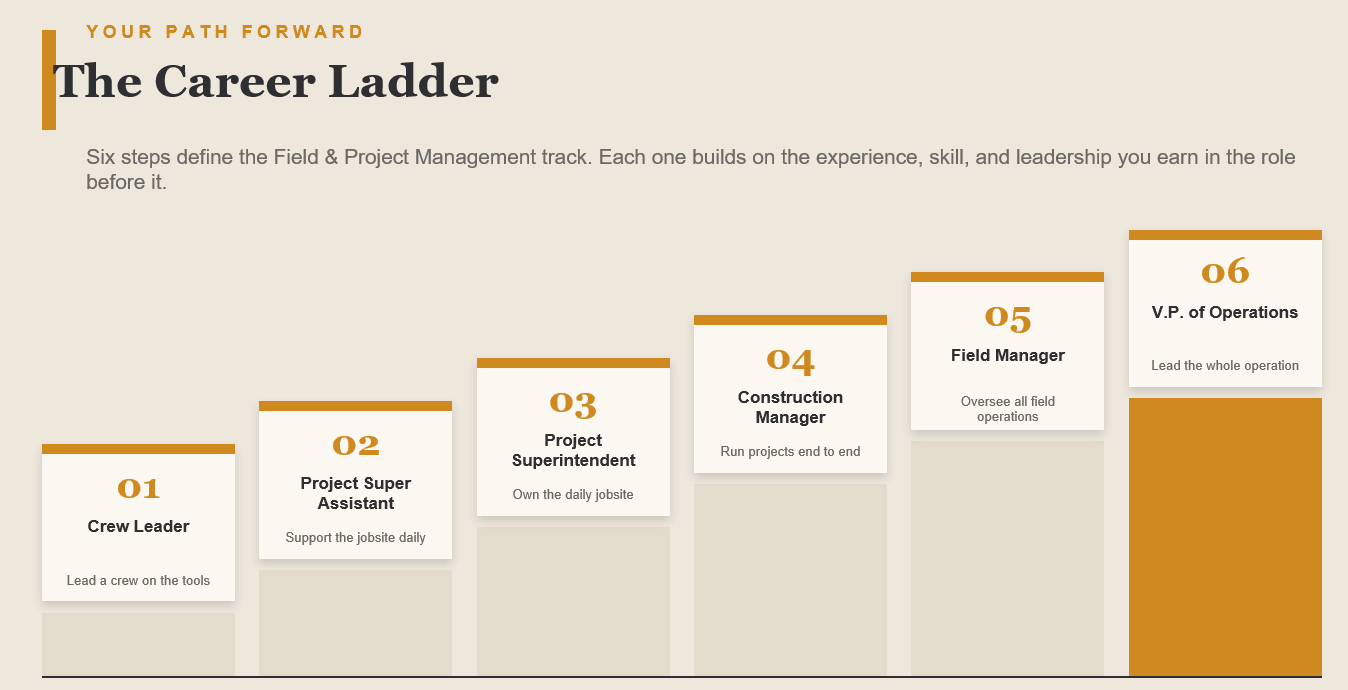
- Crew Leader: Leads a crew while remaining actively involved in the work.
- Project Superintendent Assistant: Supports the daily coordination and administration of the jobsite.
- Project Superintendent: Takes responsibility for the site’s schedule, safety, quality, and coordination.
- Construction Manager: Manages projects from startup through completion.
- Field Manager: Oversees multiple jobsites and the managers responsible for them.
- Vice President of Operations: Establishes operational strategy and helps lead company growth.
The exact titles and structure will vary among MBCEA member companies. The important point is to make progression understandable. Employees should be able to see how today’s responsibilities prepare them for tomorrow’s opportunities.
Visibility also changes the way employees view their current work. Reading plans, completing documentation, coordinating subcontractors, mentoring coworkers, or leading a safety discussion are not isolated tasks. They are opportunities to build the capabilities required at the next level.
Define the Pillars of Advancement
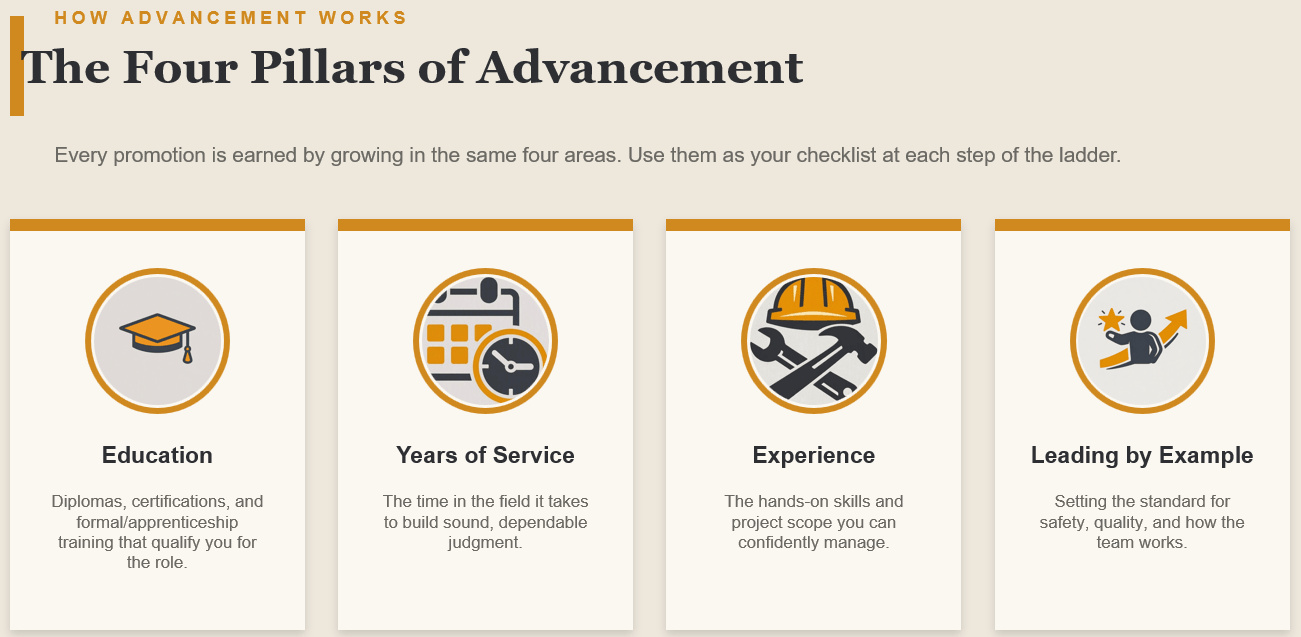
Promotions should be based on more than tenure or technical ability alone. A balanced framework can evaluate readiness across four areas: education, service, experience, and leadership.
Education and credentials
Formal qualifications establish an important foundation. Depending on the role, these may include a high school diploma or GED, trade or apprenticeship training, OSHA 10 or OSHA 30 certification, first aid and CPR training, construction-management education, or professional credentials such as the CCM or PMP.
Education should not be treated as a one-time requirement. As responsibilities expand, employees must continue developing their knowledge of safety, project controls, technology, financial management, communication, and leadership.
Years of service
Time in the field matters because sound judgment develops through experience. Employees need opportunities to see projects evolve, solve unexpected problems, and understand the consequences of operational decisions.
However, years of service should be viewed as a guide rather than an automatic trigger for promotion. Time creates opportunities to learn; it does not guarantee mastery. Advancement should reflect what an employee can consistently and confidently do.
Practical experience
Each step on the career ladder requires a broader operational perspective. A crew leader may focus on directing daily work, interpreting plans, and delivering safe, high-quality results. A superintendent coordinates schedules, subcontractors, suppliers, owners, safety, and quality control. A construction manager adds responsibility for budgets, client communication, and multiple project teams.
At senior levels, leaders must allocate resources across concurrent projects, manage company-wide operations, contribute to business development, and understand profit-and-loss performance. Technical knowledge remains important, but the scope of decision-making becomes progressively wider.
Leading by example
Leadership is the thread that connects every career stage. Employees do not need an executive title to establish standards, influence culture, or help others succeed.
At the crew level, leadership means arriving prepared, working safely, taking ownership, and setting the pace. Superintendents demonstrate it by operating organized jobsites and mentoring developing employees. Managers establish accountability, remain decisive under pressure, and create consistency across teams. Executives embody company values, set direction, and develop the leaders who will carry the organization forward.
When leadership expectations are defined at every level, culture becomes something employees practice—not simply something the company describes.
Turn the Career Ladder Into a Management System
Publishing job titles and requirements is only the beginning. A career pathway creates value when managers use it regularly.
Supervisors should discuss career goals during performance conversations and help employees identify the experiences, training, and credentials needed for the next role. Development plans should be specific enough to guide action. Instead of telling an employee to “show more leadership,” a manager might ask that person to lead a daily planning meeting, mentor a newer team member, coordinate a defined portion of the project, or complete a relevant certification.
Companies should also create opportunities for employees to practice next-level responsibilities before promotion. Stretch assignments, cross-training, mentoring, and temporary leadership opportunities allow employees to build confidence while giving managers better evidence of readiness.
This approach makes promotion decisions more consistent and helps reduce the perception that advancement depends on visibility, personal relationships, or waiting for an opening. Employees understand the standards, while managers gain a common language for evaluating performance and potential.
Strengthen Retention and Succession
Transparent career pathways benefit both employees and employers.
For employees, they provide greater control over career development. People can identify gaps, pursue relevant education, request targeted experience, and have more productive conversations with their managers.
For companies, career pathways create a stronger internal talent pipeline. Leaders can identify emerging capability earlier, prepare employees for critical roles, and reduce the disruption caused when experienced managers retire or leave the organization.
This is especially important in an industry where technical expertise and field credibility cannot be developed overnight. The superintendent, field manager, or operations executive a company will need several years from now may already be working on one of its crews today. The organization’s responsibility is to recognize that potential and provide a credible route forward.
Build the Leaders Who Will Build the Future
A strong career-development culture begins with a simple message: advancement is possible, expectations are clear, and growth is a shared responsibility.
Employees must master their current roles, pursue appropriate education and certifications, lead through safety and quality, and communicate their goals. Managers must provide honest feedback, meaningful development opportunities, and consistent standards. Company leaders must ensure that workforce development receives the same attention as other long-term operational priorities.
For MBCEA member companies, clear career pathways can become a powerful competitive advantage. They help turn jobs into careers, experienced employees into capable leaders, and individual growth into lasting organizational strength.

Metal building industry jobs can be found on the MBCEA Job Board!