
Midterm Elections and the Stock Market: What History Tells Us and Where We Go From Here
The 2026 midterm elections are now behind us, and as expected, they've brought plenty of headlines, opinions, and conversations about what the results could mean for the economy and the markets.
Democrats secured control of both the House and Senate, creating a divided government with a Republican president and Democratic-controlled Congress.
The markets initially responded positively to the results, with major U.S. stock indexes moving higher the day after the election. But as we've seen time and time again, a market reaction immediately following an election doesn't necessarily tell us what to expect over the months or years ahead.
And here's what I think is most important to remember: What happens in Washington doesn't necessarily dictate what happens with your investments.
Now that the election is behind us, I thought it would be helpful to look at what history tells us about the markets following midterm elections and what the results could mean for your financial plan.
What Does History Tell Us?
Historically, midterm elections have brought some uncertainty to the markets, but the periods following those elections have often been positive.
Here are a few statistics worth considering:
- 0%: According to Goldman Sachs Global Investment Research, the S&P 500 has historically
experienced a median return of 0% between August 1 and Election Day during midterm election
years. - 9.2% vs. 13.3%: From 1937 through 2025, the S&P 500 averaged a 9.2% annual total return in
midterm election years, compared to 13.3% in non-midterm years. - 6.6%: The S&P 500 has historically averaged a 6.6% return during the fourth quarter of midterm
election years.
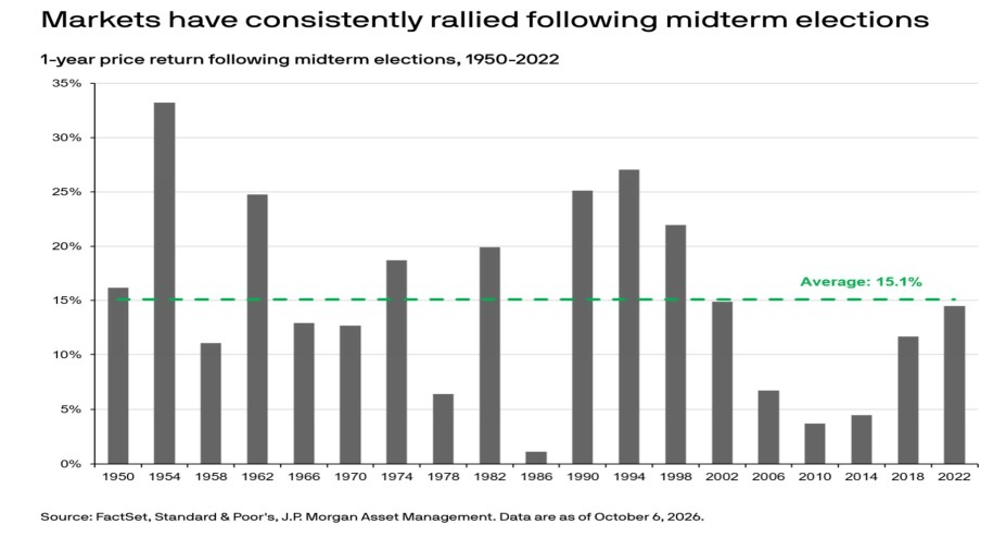
Of course, past performance doesn't guarantee future results, and every election and economic environment is different.
But I think these statistics offer some valuable perspective, especially when the headlines make it feel like everything is riding on one election.
What Do the Election Results Mean for the Markets?
With Democrats winning control of both chambers of Congress and Republicans maintaining control of the White House, we're heading into a period of divided government.
So what does that actually mean for investors?
For starters, passing major legislation may become more challenging. Significant changes to tax policy, government spending, and business regulations will likely require more negotiation and compromise.
Some investors view divided government favorably because it can limit sweeping policy changes and provide a degree of predictability. But political gridlock can also create challenges, particularly when it comes to budgets, government funding, and other legislative priorities.
The election results could also influence which industries benefit from future policy decisions and which may face additional challenges. We saw some of that play out in the markets immediately following the election, with investors reacting differently across sectors.
But here's the important part: Neither political party has a monopoly on positive market returns.
The markets have performed well under Republican leadership, Democratic leadership, and divided government. And while the political landscape has changed, the fundamental drivers of long-term investment returns haven't.
Corporate earnings, inflation, interest rates, economic growth, and consumer spending will continue to play a significant role in where markets go from here.
What Does This Mean for Your Financial Plan?
This is where I always encourage clients to focus on the bigger picture.
It's natural to wonder whether election results should change how we're investing or planning for the future. But just because the political landscape changes doesn't automatically mean your financial plan needs to. One of the reasons we put so much emphasis on financial planning is because we know there will always be things outside of our control.
Elections, market volatility, economic uncertainty, and changing tax laws are all part of the journey.
The goal isn't to predict every outcome. It's to build a financial plan that can navigate uncertainty while keeping you focused on what matters most to you. That's also why our job doesn't stop once your plan is in place. We're continually evaluating changes that could impact your taxes, investments, retirement income, and overall financial picture.
With the shift in congressional control, we'll be paying attention to potential legislative developments, particularly those involving taxes, retirement planning, and other policies that could affect our clients. If something changes that warrants a conversation or an adjustment, we'll be proactive about it.
Being proactive doesn't mean reacting to every headline. It means understanding what matters, what doesn't, and when action is actually necessary.
The Bottom Line
The election results are in, and while the political landscape may look different, the importance of having a thoughtful financial plan hasn't changed. There will always be another election, another headline, and another reason to question what the markets might do next. But your financial goals shouldn't change every time the political landscape does.
My encouragement is to stay focused on the things we can control, keep a long-term perspective, and remember that a thoughtful financial plan is designed with uncertainty in mind. As always, if you have questions about the election, the markets, or how potential policy changes could impact your personal situation, please don't hesitate to reach out.

Shannon Fowler
Private Wealth Advisor
IronBridge Wealth Counsel, LLC
636-299-8558 Mobile
Shannon.Fowler@IronBridgeWC.com
IronBridgeWC.com
Sources: J.P. Morgan Asset Management, How Do Markets Perform in Midterm Election Years? and How Do Markets Perform Post-Midterms?; Goldman Sachs Global Investment Research, as cited in the original article.
Historical performance is not a guarantee of future results. Economic forecasts may not develop as predicted, and no investment strategy is guaranteed to be successful.
Securities and investment advisory services offered through Osaic Wealth,Inc. member FINRA/SIPC. Osaic Wealth is separately owned and other entities and/or marketing names, products or services referenced here are independent of Osaic Wealth.