
ASCE 7-22 Tornado Load Bulletin
As states or municipalities begin to adopt the new ASCE 7-22, it is worth noting that Chapter 32, “Tornado Loads” has now been completed in the code. This previous blank chapter had been “reserved” and is a newly completed part of the ASCE 7 code. This chapter was planned and introduced for additional design concerns and is based on research advances, “critical facility protection”, consistency, and life safety. While this new chapter does not replace any of the current requirements from wind design criteria (Chapter 26 through 31), it could introduce additional wind loads to the building. First, this new chapter will only affect buildings defined by the Engineer of Record as Risk Category III and IV.
III
- Buildings and other structures, the failure of which could pose a substantial risk to human life
- Buildings and other structures not included in Risk Category IV, with potential to cause a substantial economic impact and/or mass disruption of day-to-day civilian life in the event of failure
- Buildings and other structures not included in Risk Category IV (including, but not limited to, facilities that manufacture, process, handle, store, use, or dispose of such substances as hazardous chemicals, hazardous waste, or explosives) containing toxic or explosive substances where the quantity of the material exceeds a threshold quantity established by the Authority Having Jurisdiction and is sufficient to pose a threat to the public if released
IV
- Buildings and other structures designated as Essential Facilities
- Buildings and other structures, the failure of which could pose a substantial hazard to the community
- Buildings and other structures (including, but not limited to, facilities that manufacture, process, handle, store, use, or dispose of such substances as hazardous fuels, hazardous chemicals, or hazardous waste) containing sufficient quantities of highly toxic substances where the quantity of the material exceeds a threshold quantity established by the Authority Having Jurisdiction and is sufficient to pose a threat to the public if released
- Buildings and other structures required to maintain the functionality of other Risk Category IV structures
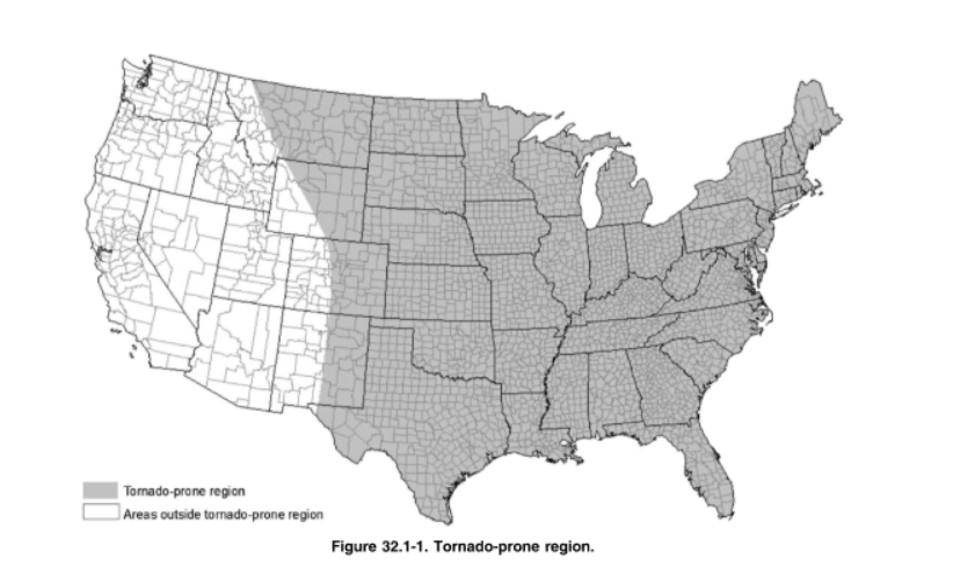
Secondly, the building must be in the Tornado Prone Region. From the map below, you can see that nearly all the region is east of the Rockies. It is worth noting that in most of the cases evaluated the new tornado wind speed design does not exceed high speeds like those in southern Florida. Of course, the engineer will consider it, but it seems to have little impact where wind speeds are high.
If both criteria above are met, then the engineer will calculate the tornado wind speeds based on the “effective plan area” of the entire facility (which may include more than one building). There has been some debate in the code and engineering community as to when additional buildings/structures should be considered in the plan area. Future codes will likely refine this definition. For now, just be aware that as the “plan area” increases, so does the potential tornado wind speed/loads. If the tornado wind speed becomes significant, it could affect the erection of the building due to the requirement of additional or heavier bracing members. It may also increase traditional frame weights.
The completion of Chapter 32 will likely not have a large impact on most erectors, but some engineers may consider the higher wind loads for temporary bracing of the higher speed requirements. For now, simply be aware that these additional requirements could impact your wind speeds if:
- The building is defined as a Risk Category III or IV.
- The “effective plan area” is significant.
- The project is east of the Rockies.
Learn more about MBCEA membership and read additional best practice articles.